
10 November 2010
Night
This is from way back when I didn't have a tripod to steady my long exposure shots; I post this because the clouds last night (when I didn't have my camera, of course) reminded me of it.


08 November 2010

06 November 2010

05 November 2010
(Not) Film
I'm going to invest in a film camera one of these days, but for now I'm left with using Photoshop to make a Diana Mini-like effect.
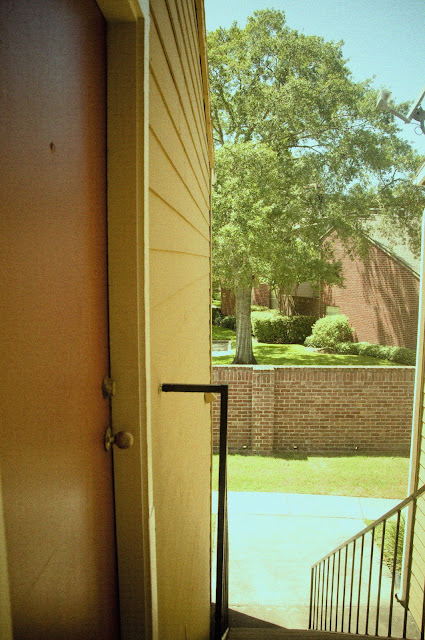
Edit: this is the entrance to my apartment!
Edit: this is the entrance to my apartment!
04 November 2010
Corner
Houston downtown, on the way to a concert by The National. Too bad they didn't allow my camera in for the actual thing.

02 November 2010

31 October 2010

30 October 2010

29 October 2010

24 October 2010
Murky
To continue the trend, another pre-exam photo demonstrating the current state of my brain: murky and under construction.
And it's still from the medical center series!

And it's still from the medical center series!
21 October 2010

20 October 2010
Lit Up
This is usually the first thing I see when coming out of the med school building after studying late at night. Not the worst thing ever...

18 October 2010

17 October 2010
Train
The train track in the middle of the road is very distinctive part of the Texas Medical Center. Especially when you're in the left turn lane and the train pulls up behind you. And honks when you don't notice the green light (true story).

16 October 2010
Construction, Part II
Really, I don't understand why I'm so attracted to the way construction sites look.

14 October 2010

13 October 2010

10 October 2010

08 October 2010
Sunset
The best a large city can do at sunset, I gather.

Also, this is my hundredth post on this blog. Woo! I would have a blogparty to celebrate, but I have absolutely no idea what that would entail.
Also, this is my hundredth post on this blog. Woo! I would have a blogparty to celebrate, but I have absolutely no idea what that would entail.
06 October 2010

05 October 2010

03 October 2010

02 October 2010
Texas Medical Center
R. Gerald Turner, president of SMU, always says, "life is too short to go to a school with an ugly campus." (That might be an imprecise paraphrase, but bear with me.) While the UT Houston Medical School building leaves much to be desired aesthetically, the Texas Medical Center itself is quite beautiful, especially at night. I finally got the chance to just walk around the med center with my headphones in and my camera at hand, at sunset and through complete darkness, and the series of photos I post in the next week or more will be from that excursion.
Enjoy!

This isn't the actual medical school building where my classes are, but probably a research building owned by the school.
Enjoy!
This isn't the actual medical school building where my classes are, but probably a research building owned by the school.
01 October 2010


29 September 2010

28 September 2010
Reli
I think I should post a few Vatican photos from when I was in Rome in October of 2008. No particular reason, except that it was a great trip.

Really, over-exposure works sometimes.
Also this was taken on an old Canon Powershot rather than on my Nikon D90, so the black-and-white conversion is not quite what I would have liked. But better than some point-and-shoot cameras I've seen.
Really, over-exposure works sometimes.
Also this was taken on an old Canon Powershot rather than on my Nikon D90, so the black-and-white conversion is not quite what I would have liked. But better than some point-and-shoot cameras I've seen.
19 September 2010

14 September 2010

11 September 2010
Tilt-Shift
If only I had time and equipment to really research and get into tilt-shift photography. It can achieve quite a few things, but one of the more amazing results is that the resulting photograph looks like a miniature diorama. Here is the Flickr set of tilt-shift photos. Hard to believe they are photos of real scenes.
And, here is an amazing video by Keith Loutit putting tilt-shift in motion:
Thanks to Sam Smith (Ben Folds' drummer and excellent graphics designer) for turning me on to this.
And, here is an amazing video by Keith Loutit putting tilt-shift in motion:
Bathtub IV from Keith Loutit on Vimeo.
Thanks to Sam Smith (Ben Folds' drummer and excellent graphics designer) for turning me on to this.
10 September 2010
An Ode To Birthdays
The problem, of course, is that
The bleary excitement of the day ahead
Is no longer a frazzled nod to something special,
A small reprieve from Copernican doctrine.
The day ahead, of course, is that
Blindingly problematic emblem
Of a condition so universal,
A veritable canon incarnate.
Of course, but how can you miss
The ocean at your feet,
The clouds at your fingertips,
Hey! You should eat that cotton candy.
Dedicated to the wonderful man in this photo.
Happy birthday!

The bleary excitement of the day ahead
Is no longer a frazzled nod to something special,
A small reprieve from Copernican doctrine.
The day ahead, of course, is that
Blindingly problematic emblem
Of a condition so universal,
A veritable canon incarnate.
Of course, but how can you miss
The ocean at your feet,
The clouds at your fingertips,
Hey! You should eat that cotton candy.
Dedicated to the wonderful man in this photo.
Happy birthday!

09 September 2010

08 September 2010

03 September 2010
Shadow

Taken with my friend's Diana Mini, a film camera of glorious proportions, literally and figuratively. This was probably a 1-2 second manual exposure at the "sunny" setting (higher f-stop, I assume?), although I can't remember exactly what I did.
01 September 2010

31 August 2010

28 August 2010

27 August 2010

26 August 2010

23 August 2010

21 August 2010
I interrupt the creeper series because I just have to post this - amazing photos from the Russian Empire circa 1910, in color! Apparently the photographer took several photos with different colored filters in quick succession, and they were recently combined to make very modern-day looking photos of 1910. It's like looking through a time portal - gives me shivers.
Check it out!
Check it out!

20 August 2010
Couple
Thus begins the slightly creeper series that was inspired by this shot that I fired off very quickly and without much thought (so as not to be detected, of course).

The Getty Museum, Los Angeles, CA.
The Getty Museum, Los Angeles, CA.
18 August 2010

16 August 2010
Medical School, Day 1
I started medical school today. Mostly the day consisted of administrative jumble, packed classrooms (for probably the last time), and not much in the way of new information. This means, of course, that I will start studying in earnest tomorrow, but for today, I am left only to reflect on my first encounter with the gross anatomy cadaver.
Although I am infinitely curious about the inner workings of the body, I am also similarly impressed by the human condition in general, and I was a little weary to beginning dissection; it’s quite easy to empathize oneself into a fainting spell, and in a room full of jagged metal tanks and linoleum floors. The tanks, by the way, are stainless steel and appear far too small to fit a human body, so it is that much more disturbing when the cadaver is finally lifted out of its resting place into the glaring fluorescent light.
But it wasn’t disturbing. With a mere six students per body, it is an intimate experience, and my first thoughts were not of bracing myself for the imminent swoon, but of thanks to the dear old man who had the foresight to donate his body for my education. All I know of him is what I can see, his bodily condition immediately before death, his numbered tag.
Thanks, #5----- of the UT Houston Medical School gross anatomy lab.
The subtitle to the title of this blog is a quote by Hippocrates, and if art is one path to immortality, then immortality consists at least in part in being remembered through one’s work; Antoine Roquentin of Sartre’s Nausea comes to approximately the same conclusion. #5-----, if not immortality, then you’ve earned at least a brief reprieve, a place in the life of someone you never knew.
-------
When we saw what may be as good a heaven as any:

Although I am infinitely curious about the inner workings of the body, I am also similarly impressed by the human condition in general, and I was a little weary to beginning dissection; it’s quite easy to empathize oneself into a fainting spell, and in a room full of jagged metal tanks and linoleum floors. The tanks, by the way, are stainless steel and appear far too small to fit a human body, so it is that much more disturbing when the cadaver is finally lifted out of its resting place into the glaring fluorescent light.
But it wasn’t disturbing. With a mere six students per body, it is an intimate experience, and my first thoughts were not of bracing myself for the imminent swoon, but of thanks to the dear old man who had the foresight to donate his body for my education. All I know of him is what I can see, his bodily condition immediately before death, his numbered tag.
Thanks, #5----- of the UT Houston Medical School gross anatomy lab.
The subtitle to the title of this blog is a quote by Hippocrates, and if art is one path to immortality, then immortality consists at least in part in being remembered through one’s work; Antoine Roquentin of Sartre’s Nausea comes to approximately the same conclusion. #5-----, if not immortality, then you’ve earned at least a brief reprieve, a place in the life of someone you never knew.
-------
When we saw what may be as good a heaven as any:
15 August 2010

13 August 2010

12 August 2010

29 July 2010
What's Better
Reunion Tower or the moon?

I'm off to California, so there will be a break in posts for a week or so, unless I'm able to post some photos while I'm there.
Adieu for now!
I'm off to California, so there will be a break in posts for a week or so, unless I'm able to post some photos while I'm there.
Adieu for now!
28 July 2010
Or Maybe
(Continued from previous post)
Thinking about determinism can get wishful sometimes:
A man lay in bed, half awake after a long night's restful sleep. The light slanted invitingly through the half-drawn curtains, not too bright but not too dreary. Early morning hunger rolled over the man, a consequence of an early dinner the night before. "Well," he thought, "if I'm fated to have eggs this morning, I'll get them whether I choose to get up now or not, so why bother."
He is still hungry today.
The Stoics and Sartre are on much more common ground than it would appear, for the Stoics did not believe in inaction because of fate. The fact of the matter is that at the moment of action, there is a necessary "illusion" of freedom, a choice that must be made, despite the fact that what that choice will be is predetermined by a prior cause. The Stoic Chryisippus offered the analogy of a cylinder pushed down a hill: the fact that it's rolling is caused not by the cylinder but by the initial push, but at each moment it rolls only because of its own (round) nature. And, it seems to me, similarly with Sartre: the situation one is in may be utterly out of one's control, but it is the choice to act therein that matters most. Sartre finds it of utmost importance to realize the uncontrollable nature of one's surroundings, and to act with that in mind. In the end, I think Sartre brings to the forefront of the definition of the human condition what the Stoics use as a backdrop to their own ethics: the thrownness of people into the world, the not-up-to-us nature of that world, and the need to act boldly anyhow.
A final word: jazz music strikes me as the perfect embodiment of this view of determinism and free will - a set of pre-determined rules, places that the notes should go and must go, and yet a culture of improvisation, a choice made at each moment as the musician plays, each performance unique and fleeting.
-----
I present to you Dallas:

Thinking about determinism can get wishful sometimes:
A man lay in bed, half awake after a long night's restful sleep. The light slanted invitingly through the half-drawn curtains, not too bright but not too dreary. Early morning hunger rolled over the man, a consequence of an early dinner the night before. "Well," he thought, "if I'm fated to have eggs this morning, I'll get them whether I choose to get up now or not, so why bother."
He is still hungry today.
The Stoics and Sartre are on much more common ground than it would appear, for the Stoics did not believe in inaction because of fate. The fact of the matter is that at the moment of action, there is a necessary "illusion" of freedom, a choice that must be made, despite the fact that what that choice will be is predetermined by a prior cause. The Stoic Chryisippus offered the analogy of a cylinder pushed down a hill: the fact that it's rolling is caused not by the cylinder but by the initial push, but at each moment it rolls only because of its own (round) nature. And, it seems to me, similarly with Sartre: the situation one is in may be utterly out of one's control, but it is the choice to act therein that matters most. Sartre finds it of utmost importance to realize the uncontrollable nature of one's surroundings, and to act with that in mind. In the end, I think Sartre brings to the forefront of the definition of the human condition what the Stoics use as a backdrop to their own ethics: the thrownness of people into the world, the not-up-to-us nature of that world, and the need to act boldly anyhow.
A final word: jazz music strikes me as the perfect embodiment of this view of determinism and free will - a set of pre-determined rules, places that the notes should go and must go, and yet a culture of improvisation, a choice made at each moment as the musician plays, each performance unique and fleeting.
-----
I present to you Dallas:
27 July 2010
Not So Free, Or Maybe
The Stoics are some of my favorite Ancient Greek philosophers – not only does the word “stoicism” arise from them (and not the other way around), but they subscribe to a host of ideas that at first seems most counterintuitive, but that grows on you as the arguments proceed, the paragon of good philosophy. There is a ton to their views, and I could go on and on about them, but it is the Stoic position on fate and determinism that I find most fascinating.
The Stoics find moral luck to be abhorrent. That is, that someone should be held responsible for something outside of their control is to them an untenable position: that only one of two drunk drivers is punished because only one happens to hit a pedestrian because that pedestrian happens to be there seems resolutely unfair to the Stoics. (Not that they mean to say that neither is culpable – it’s that only one is in fact punished that is the problem.) Thus, they take it to be the case that one can only be responsible for, and one should only care about, those things that one can control. And therein lies the rub, for the Stoics take it to be the case that all events are determined, that every event (and human action) has a preceding cause, and thus, since no alternative is open at the moment of action, that there is no such thing as free will. From this, the Stoics can find it irrational to display overt emotion, because, for example, anger at someone’s action involves the belief that the action could have proceeded differently, which in fact it couldn’t have.
This, then, is where Sartre comes in, for he holds that true freedom rests not in imagining one’s situation to be different and wishing it were so, but in acting given one’s facticity, making choices within the situation one finds oneself in and making the best of it. Freedom, to Sartre, is not lying to oneself about one’s situation, and making decisions based on and wholly within that situation. It’s a balance between, on the one hand, the constraints of body and worldly condition, and on the other, the ability to imagine being above those constraints, and most of all being able to act on that imagination while understanding and accepting one’s physical constraints.
It would appear, then, that the Stoics and Sartre are much at odds, for how can one resolve to act, even given an understanding of one’s facticity, if all actions are predetermined anyhow?
-----
I leave the question unanswered until next time, and leave the discussion for now with this possibly unrelated and possibly related photo.

The Stoics find moral luck to be abhorrent. That is, that someone should be held responsible for something outside of their control is to them an untenable position: that only one of two drunk drivers is punished because only one happens to hit a pedestrian because that pedestrian happens to be there seems resolutely unfair to the Stoics. (Not that they mean to say that neither is culpable – it’s that only one is in fact punished that is the problem.) Thus, they take it to be the case that one can only be responsible for, and one should only care about, those things that one can control. And therein lies the rub, for the Stoics take it to be the case that all events are determined, that every event (and human action) has a preceding cause, and thus, since no alternative is open at the moment of action, that there is no such thing as free will. From this, the Stoics can find it irrational to display overt emotion, because, for example, anger at someone’s action involves the belief that the action could have proceeded differently, which in fact it couldn’t have.
This, then, is where Sartre comes in, for he holds that true freedom rests not in imagining one’s situation to be different and wishing it were so, but in acting given one’s facticity, making choices within the situation one finds oneself in and making the best of it. Freedom, to Sartre, is not lying to oneself about one’s situation, and making decisions based on and wholly within that situation. It’s a balance between, on the one hand, the constraints of body and worldly condition, and on the other, the ability to imagine being above those constraints, and most of all being able to act on that imagination while understanding and accepting one’s physical constraints.
It would appear, then, that the Stoics and Sartre are much at odds, for how can one resolve to act, even given an understanding of one’s facticity, if all actions are predetermined anyhow?
-----
I leave the question unanswered until next time, and leave the discussion for now with this possibly unrelated and possibly related photo.
Subscribe to:
Posts (Atom)